


 English
 русский
 Español
 中文简体
中文简体Content
- 1 Why PP Is the Default Material for Disposable Cup Lids
- 2 Main Types of Disposable PP Cup Lids
- 3 PP Cup Lid Types at a Glance
- 4 Sizing and Compatibility: The Most Common Sourcing Mistake
- 5
- 6 Food Safety Compliance and Certifications to Request
- 7 Key Specifications to Define Before Requesting Quotes
- 8 Evaluating PP Cup Lid Suppliers: What to Look for Beyond Price
Why PP Is the Default Material for Disposable Cup Lids
Polypropylene — PP — has become the dominant material for disposable cup lids across foodservice, beverage, and takeaway applications, and the reasons are practical rather than arbitrary. PP offers a combination of properties that competing plastics struggle to match at the same cost point: it is food-safe, semi-rigid without being brittle, resistant to a broad range of temperatures, and compatible with the injection molding and thermoforming processes used to produce lids at high volume with tight dimensional tolerances.
From a food contact perspective, PP is one of the most widely approved plastics globally. It does not leach harmful plasticizers under normal use conditions, tolerates hot beverages without deforming at temperatures up to approximately 120–130°C depending on grade, and is chemically inert to the acids, oils, and alcohols present in most food and beverage products. This makes a food grade PP lid suitable for applications ranging from hot coffee and soup to cold smoothies and bubble tea — a versatility that single-material alternatives like PS (polystyrene) or PET cannot match across the full temperature range. For buyers sourcing at scale, PP's combination of performance, regulatory compliance, and competitive unit cost makes it the logical starting point for most disposable cup lid requirements.
Main Types of Disposable PP Cup Lids
Not all PP cup lids are interchangeable. The lid type determines how the product is used, what cup formats it fits, and what functional requirements it meets — and choosing the wrong lid type for an application creates problems that no amount of price negotiation will fix. Understanding the main categories is the first step in any sourcing decision.
Flat Sip-Hole Lids
Flat PP lids with a pre-formed sip hole or cross-cut opening are the standard format for hot beverage applications — coffee cups, tea, hot chocolate — where a low profile lid is preferred and direct sipping from the cup is the intended use. The flat profile minimizes material usage per unit, which keeps unit cost low and reduces stacking height in storage and transport. The sip opening is typically either a die-cut cross (which the lip pushes open) or a molded oval aperture, and the lid rim is designed to snap securely onto the cup flange with enough retention force to prevent accidental removal but enough ease to allow intentional lid-off access. For high-volume coffee and tea applications — cafes, fast food chains, office catering — flat sip lids represent the most cost-effective PP lid format per unit.
Dome Lids
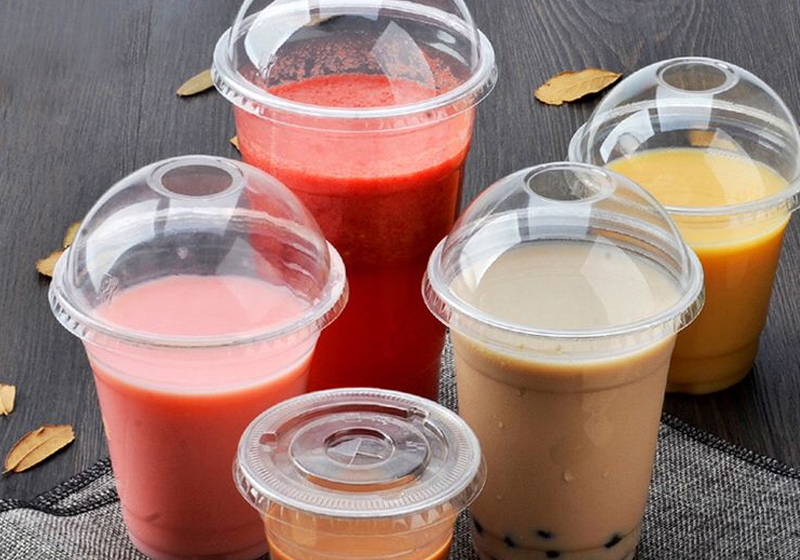
Dome-shaped PP lids provide headroom above the cup rim, making them the standard choice for cold beverages served with whipped cream, blended ice, toppings, or straw insertion. The dome height varies by product — a shallow dome for standard iced coffee or cold brew, a taller dome for topped drinks like frappes or bubble tea. Dome lids typically include a straw slot or pre-punched straw hole, and many designs incorporate a small vent hole on the opposite side to prevent vacuum buildup when drinking through a straw. For bubble tea and boba applications specifically, wide-diameter straw holes (typically 12–14mm to accommodate fat boba straws) are a key specification that must be confirmed before ordering — a standard straw slot designed for 6mm straws is not interchangeable with a boba straw opening.
Peelable and Sealing Lids
Peelable PP lids — heat-sealed or pressure-sealed film lids applied over cup rims using sealing equipment — are used in food delivery, grab-and-go retail, and packaged food applications where spill prevention and tamper evidence are required. These are distinct from snap-on lids: they require a compatible sealing machine and specific cup rim profiles to achieve a reliable seal, and the lid film must be matched to the cup material for the seal to hold under the expected handling conditions. For buyers in the food delivery or prepared food retail segment, peelable lids offer a meaningful operational advantage — a sealed cup is more secure during transit and provides a visible tamper indicator — but the equipment investment and compatibility requirements add complexity compared to snap-on lid sourcing.
Specialty Lids: Vented, No-Hole, and Custom Formats
Beyond the main categories, the disposable PP lid market includes specialty formats for specific applications. Fully closed lids with no sip hole or straw slot are used for soups, broths, and liquid foods where spill prevention without straw access is the priority. Vented lids with multiple small holes allow steam to escape from hot food containers without buildup of pressure or condensation pooling. Custom-printed or custom-embossed lids carry brand logos or messaging and are available from manufacturers at minimum order quantities that vary significantly by supplier — typically 50,000 to 500,000 units for injection-molded custom tooling. For buyers with brand identity requirements, custom lids are worth evaluating even at the additional cost, as they function as a high-frequency touchpoint with end consumers.
PP Cup Lid Types at a Glance
| Lid Type | Profile | Primary Application | Key Spec to Check |
| Flat Sip Lid | Low profile | Hot coffee, tea | Rim diameter, sip opening type |
| Shallow Dome | Low dome | Iced coffee, cold brew | Straw hole diameter, dome height |
| Tall Dome | High dome | Frappes, topped drinks, bubble tea | Dome height, straw slot size |
| Peelable Seal Lid | Film flat | Delivery, grab-and-go retail | Sealer compatibility, film-cup bond |
| Closed / No-Hole Lid | Flat or low dome | Soups, broths, liquid food | Snap retention force, rim fit |
| Vented Lid | Flat with vents | Hot food containers | Vent count, steam release rate |
Sizing and Compatibility: The Most Common Sourcing Mistake
Lid-to-cup compatibility is the single most frequent source of problems in disposable PP cup lid sourcing, and it is entirely avoidable with the right specification process. A lid that does not fit its cup correctly — either too loose and prone to popping off, or too tight and requiring excessive force to apply — creates operational problems at the point of service and increases spill incidents during handling and transport. The root cause in most cases is a mismatch between the lid rim diameter and the cup flange diameter, compounded by the fact that industry sizing terminology is not standardized across manufacturers.
Cup sizing labels like "12oz," "16oz," and "24oz" refer to fill volume but do not specify rim diameter — and different cup manufacturers produce cups of the same nominal volume with different rim diameters. A 16oz cup from one manufacturer may have a 90mm rim diameter while a 16oz cup from another has an 87mm rim. The correct approach when sourcing PP lids is to measure the actual outer rim diameter of your cups in millimeters and source lids specified to that dimension, not to the volume label. Request sample lids from suppliers before committing to a volume order and physically test the fit on your actual cups: the lid should snap on with moderate hand pressure and require deliberate effort to remove, with no wobble or gap around the rim perimeter.
Common Rim Diameter Ranges by Cup Size
| Nominal Cup Size | Typical Rim Diameter Range | Notes |
| 8–10 oz | 80–85mm | Espresso, small hot drinks |
| 12–16 oz | 87–92mm | Most common cafe size range |
| 20–24 oz | 95–100mm | Large cold drinks, bubble tea |
| 32 oz+ | 105–115mm | Jumbo formats, QSR large sizes |
Food Safety Compliance and Certifications to Request
For any buyer sourcing disposable PP cup lids for food and beverage applications, compliance documentation is not optional — it is a baseline requirement that protects both end consumers and the buyer's own liability position. The regulatory requirements for food contact plastics vary by market, and confirming that a supplier's products meet the relevant standards for your target markets before placing a volume order is far less costly than discovering a compliance gap after the fact.
In the European Union, food contact materials are governed by Regulation (EC) No 1935/2004 and the specific plastics regulation (EU) No 10/2011, which sets overall migration limits and specific migration limits for individual substances that may transfer from the plastic into food. Suppliers serving the EU market should be able to provide a Declaration of Compliance (DoC) for their PP lid products, confirming compliance with these regulations and identifying the specific PP resin grade used. In the United States, FDA regulations under 21 CFR cover food contact materials including polypropylene, and suppliers should be able to confirm their raw material is FDA-compliant for the intended food contact application. For markets in Asia-Pacific, China's GB standards for food contact plastics (GB 9693 for PP specifically) apply to products sold or manufactured in mainland China.
- EU Declaration of Compliance: Confirms compliance with (EU) No 10/2011 and relevant migration limits — request this for any supplier serving European markets
- FDA food contact compliance letter: Confirms the PP resin is suitable for the intended food contact application under US regulations
- LFGB certification (Germany): The German LFGB standard is stricter than the general EU framework and is frequently requested by German buyers and retailers
- REACH compliance: Confirms the product does not contain substances of very high concern (SVHCs) on the REACH candidate list above threshold concentrations
- Third-party migration test reports: Independent laboratory testing for overall migration and specific substance migration is more reliable than supplier declarations alone — request recent test reports for the specific product SKU, not generic material certificates
Key Specifications to Define Before Requesting Quotes
A vague RFQ produces vague quotes that are difficult to compare and often lead to wrong products arriving on the first order. Defining your requirements precisely before approaching suppliers shortens the sourcing cycle, produces comparable quotes, and reduces the risk of receiving product that doesn't work with your cups or application. These are the specifications worth nailing down before you start the conversation.
- Lid type: Flat sip, dome (specify height), peelable, or closed — confirm the format matches your cup and end-use application
- Rim diameter in mm: Measure your cups directly — do not rely on nominal size labels for this specification
- Wall thickness: Affects rigidity, snap retention, and unit cost — standard ranges are 0.3–0.6mm for most foodservice lids; heavier gauge for premium or reuse-intended formats
- Temperature range: Confirm the lid is rated for the maximum temperature of your application — especially important for hot beverages and microwave-safe claims
- Straw hole specification: Diameter in mm and whether a plug or flap seal is required — critical for boba and specialty beverage applications
- Color and transparency: Clear, frosted, or opaque; standard colors or custom — confirm availability at your required MOQ
- Printing or embossing: Logo, text, or pattern requirements and associated MOQ and tooling costs
- Packaging format: Sleeve count, carton quantity, and pallet configuration — affects storage footprint and inbound logistics planning
Evaluating PP Cup Lid Suppliers: What to Look for Beyond Price
Unit price is the most visible variable when comparing PP cup lid suppliers, but it is rarely the most important one for buyers sourcing at meaningful scale. Consistency, compliance documentation, lead time reliability, and minimum order flexibility are the factors that most directly affect the operational reality of working with a supplier over time — and suppliers who win on price alone often create costs elsewhere in the supply chain that more than offset the unit cost advantage.
Production Consistency and Quality Control
Dimensional consistency is the most operationally critical quality parameter for cup lids. A lid that fits correctly on 95% of cups but pops off or won't snap onto 5% creates a measurable service problem at scale — in a cafe serving 500 drinks per day, that's 25 lid failures daily. Ask suppliers about their dimensional control process: what tolerances are they holding on rim diameter and snap fit, how frequently are molds inspected for wear, and what is their process for handling out-of-specification batches. Suppliers with ISO 9001 quality management certification have documented processes for these controls; those without should be able to describe their equivalent approach clearly.
Minimum Order Quantities and Flexibility
MOQ structures for disposable PP cup lids vary widely between suppliers and significantly affect the practical options available to buyers at different scales. Larger manufacturers typically set MOQs at carton or pallet level — 10,000 to 50,000 units per SKU is common — while smaller or trading-focused suppliers may accommodate lower volumes at higher unit cost. For buyers running multiple cup sizes or formats, the ability to split an order across several SKUs at a combined MOQ is worth asking about explicitly. Equally important is lead time for repeat orders: confirm whether the supplier holds finished goods inventory for standard SKUs or manufactures to order, as this directly determines how much safety stock you need to maintain and how responsive the supply chain is to demand spikes.
Sample Evaluation Before Committing
No supplier evaluation process for disposable PP cup lids should skip physical sample testing before a volume order is placed. Request samples of the exact SKU you intend to order — not a similar product from the same range — and test them against your actual cups across the full range of sizes in use. Evaluate snap fit force, lid removal effort, leak resistance when tilted, structural integrity under normal handling, and straw hole performance with the straw format your operation uses. If the application involves hot beverages, test the lid on a cup filled with water at the maximum intended serving temperature and confirm there is no deformation, discoloration, or odor transfer after a realistic dwell time. Document the sample results and use them as a baseline specification reference for incoming inspection on subsequent orders.