


 English
 русский
 Español
 中文简体
中文简体Content
- 1 What Makes a Paper Box Suitable for Sushi Packaging
- 2 Paper and Coating Materials Used in Sushi Boxes
- 3 Common Structural Designs and When to Use Each
- 4 Size Options and How to Match Them to Your Menu
- 5 Food Safety and Certification Requirements
- 6 Printing and Branding Options for Custom Sushi Boxes
- 7 Sustainability Considerations Worth Knowing
- 8 Practical Tips for Sourcing and Ordering
What Makes a Paper Box Suitable for Sushi Packaging
Sushi places specific demands on packaging that most standard food boxes are not designed to meet. The combination of raw fish, vinegared rice, and moist fillings creates a moisture-rich environment that will degrade ordinary paperboard within minutes if the material is not treated or coated appropriately. A good disposable sushi paper box needs to handle moisture without losing structural integrity, maintain a stable internal environment that keeps the contents at the right temperature during transit, and present the product attractively when the customer opens the box.
Beyond moisture resistance, the box needs to be food-safe. Any coating, ink, or adhesive used in the construction must comply with applicable food contact material regulations, since sushi — particularly sashimi and nigiri — sits directly on or very close to the box surface. This is not a minor detail: food contact compliance is a procurement requirement for most commercial food service operators and a legal obligation in most markets. A disposable sushi container that looks good but fails on food safety or structural performance creates real operational and liability problems for the businesses using it.
Paper and Coating Materials Used in Sushi Boxes
The base material and surface treatment of a disposable sushi paper box determine most of its functional characteristics. Understanding the options helps in matching the packaging to the specific needs of the product and the service context.
Coated Paperboard
The most common base material for sushi takeout paper boxes is solid bleached sulfate (SBS) or folding box board (FBB) coated with a moisture-resistant layer. The coating is typically applied to the inner surface and is what prevents rice moisture and fish oils from saturating the board and causing the box to lose shape. Clay-coated exteriors provide a smooth, printable surface for branding and graphics. This construction balances cost, printability, and adequate moisture resistance for typical sushi service windows of one to three hours.
PE-Lined Paperboard
Polyethylene-lined paperboard adds a thin PE film layer to the interior surface, significantly improving moisture and grease resistance compared to clay-coated board alone. This construction is better suited for sushi boxes that will hold rolls with sauces, heavily dressed items, or products that will be transported over longer distances or held for more than two hours before consumption. The tradeoff is that PE lining makes the box harder to recycle through standard paper streams, which is a consideration for businesses with sustainability commitments or customers in regions with strict packaging recycling requirements.
PLA-Coated or Compostable Board
Polylactic acid (PLA) coating is a plant-based alternative to PE that provides comparable moisture resistance while qualifying the box as compostable under industrial composting conditions. PLA-coated sushi paper boxes are increasingly specified by restaurants and food delivery operators targeting sustainability-conscious customers or operating in jurisdictions where single-use plastic coatings are regulated or taxed. It is important to note that PLA-coated boxes require industrial composting infrastructure to break down — they will not compost reliably in home bins or standard landfill conditions.
Kraft Paper Construction
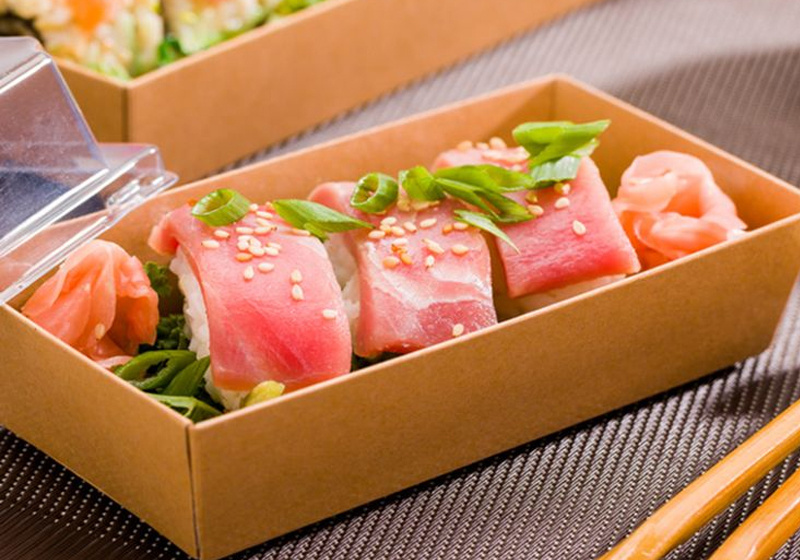
Natural brown kraft paperboard is used in sushi packaging aimed at the premium natural or organic food segment. Kraft-based sushi boxes typically rely on a food-grade inner coating for moisture resistance and carry unbleached brown exteriors that communicate an artisan or eco-friendly brand positioning. Print quality on uncoated kraft surfaces is lower than on white SBS board, so businesses with complex branding or high-detail graphics should verify print results before committing to kraft-based packaging.
Common Structural Designs and When to Use Each
Disposable sushi paper boxes come in several structural configurations, each suited to a different type of product and service context. Choosing the wrong structure for the product creates problems at the point of use — lids that don't seal properly, pieces that shift during transport, or presentation that doesn't reflect the quality of the food inside.
| Box Style | Best For | Key Feature |
| Tray with separate lid | Nigiri sets, sashimi platters, mixed rolls | Full visibility of contents; clean presentation |
| Hinged lid (clamshell) | Takeout rolls, combo boxes, delivery orders | One-piece construction; secure closure for transit |
| Window lid box | Gift sets, premium retail packaging | Clear PET window shows product without opening |
| Compartmented tray | Bento-style sets with sushi and sides | Keeps components separated during transport |
| Sleeve-style wrap box | Individual rolls, casual fast-casual formats | Compact footprint; low material cost per unit |
| Boat or tray without lid | Dine-in service, display counters | Open presentation; not suitable for transit |
For most takeout and delivery operations, the hinged clamshell and the tray-with-lid formats dominate because they combine secure closure with reasonable presentation quality. Window lid boxes add cost but are worth considering for premium retail or gift-oriented sushi products where visual appeal at the point of sale directly affects purchase decisions.
Size Options and How to Match Them to Your Menu
Sushi paper boxes are available in a range of standard sizes, and getting the size right matters more than many operators initially expect. A box that is too large allows pieces to slide and rearrange during transit, arriving at the customer in a visually unappealing state. A box that is too small compresses the contents, damaging delicate toppings and disrupting the structure of pressed or assembled rolls.
Standard sizes for disposable sushi takeout boxes typically range from small single-serve formats holding four to six pieces up to large party or catering trays designed for twenty-four pieces or more. Common intermediate sizes — eight-piece and twelve-piece formats — are the most widely stocked and tend to offer the best pricing for mid-volume orders. If your menu features specialty large rolls, thick uramaki, or oversized nigiri, verify the internal height of the box as well as the footprint: taller items need boxes with adequate internal clearance to avoid the lid pressing down on toppings.
For operations running bento-format menus that combine sushi with rice, edamame, or side salads, compartmented trays in 20cm x 28cm or 22cm x 30cm footprints are the most common format. Confirm internal compartment dimensions against your actual portion sizes before ordering, since compartment layouts vary between suppliers even within nominally identical tray sizes.
Food Safety and Certification Requirements
Any disposable sushi paper box used in commercial food service needs to meet food contact material safety standards applicable in the market where it is sold. The specific certification required depends on geography, but the underlying requirements are similar: the materials used in construction must not transfer harmful substances to the food at levels that could affect human health or alter the taste, smell, or appearance of the food.
- EU markets: Food contact materials must comply with EU Regulation 1935/2004 and relevant specific measures. For paperboard packaging, suppliers should provide a Declaration of Compliance (DoC) confirming that the material meets applicable migration limits. If the board or coating contains recycled fiber, additional testing under EN 15519 or similar standards may be required.
- US markets: Food contact paper and board materials must comply with FDA regulations under 21 CFR, specifically sections covering paper and paperboard components. Request a letter of guarantee or food contact compliance documentation from the supplier confirming compliance with applicable CFR sections.
- Inks and coatings: The outer surface inks and any interior coatings must be food-safe. Request confirmation that inks are formulated to food contact standards (such as EuPIA Good Manufacturing Practice guidelines for printing inks) and that no restricted substances are present above permissible migration limits.
- Recycled content: Boxes made with recycled paperboard require more careful compliance review, since recycled fiber can carry trace contaminants from previous use cycles. If recycled content is a priority, ensure the supplier can demonstrate that recycled fiber is tested and that migration levels meet applicable food contact limits.
Printing and Branding Options for Custom Sushi Boxes
Custom-printed disposable sushi paper boxes are a practical branding tool for restaurants, sushi chains, and food delivery operators. The box is one of the last brand touchpoints before the customer interacts with the food, and a well-designed box reinforces the quality perception of the product inside. For delivery-focused operations, custom packaging also provides social media visibility when customers photograph and share their meals.
Offset lithographic printing is the standard method for high-volume custom sushi box production. It delivers the best color fidelity and fine detail reproduction on coated SBS board and is cost-effective at quantities of 5,000 units and above. Flexographic printing is more common for kraft and uncoated board surfaces and is typically used for simpler, two- or three-color designs. Digital printing is available for very short runs or for personalized or variable-data applications, but unit costs are significantly higher than offset or flexo at volumes relevant to most food service businesses.
Minimum order quantities for custom-printed sushi paper boxes typically start at 1,000 to 2,000 units for simple designs from domestic suppliers, and 5,000 to 10,000 units for offshore production. Lead times for custom orders range from two to four weeks for domestic runs and six to twelve weeks when sourcing from overseas manufacturers. Factor these lead times into inventory planning, particularly for seasonal promotions or new menu launches.
Sustainability Considerations Worth Knowing
The environmental profile of a disposable sushi paper box depends heavily on material construction, end-of-life options, and the supply chain behind the raw materials. Paper-based packaging is broadly perceived as more sustainable than plastic alternatives, but the reality is more nuanced and depends on which specific materials and coatings are used.
- FSC certification: Boxes made from Forest Stewardship Council (FSC)-certified paperboard confirm that the virgin fiber content comes from responsibly managed forests. This is the baseline certification that most sustainability-focused buyers and retailers require from their paper packaging suppliers.
- Recyclability: Plain coated paperboard sushi boxes are generally recyclable through standard paper recycling streams, provided they are not heavily soiled with food residue. PE-lined boxes are typically not accepted in standard paper recycling and need to go to waste streams that can handle multi-material packaging.
- Compostability claims: Boxes marketed as compostable should carry certification from a recognized scheme such as TÜV Austria (OK Compost), DIN CERTCO, or BPI in the US. Without third-party certification, compostability claims are difficult to verify and may not hold up under regulatory scrutiny in markets where green claims are actively monitored.
- Recycled content: Some suppliers offer sushi boxes made with a percentage of post-consumer recycled fiber. As noted in the food safety section, recycled content requires additional compliance verification for food contact applications, so request supporting documentation before specifying recycled-content board for direct food contact use.
Practical Tips for Sourcing and Ordering
Getting the procurement side of disposable sushi paper boxes right saves time and avoids the operational disruption of running out of stock or receiving a product that doesn't perform as expected. A few practical steps make the process significantly smoother.
- Always request physical samples before committing to a bulk order. Test samples with your actual product — fill the box with representative sushi items, close the lid, refrigerate for the expected hold time, and then simulate a delivery transit by moving the box around. Look for moisture bleed-through on the base, lid seal performance, and whether the contents stay in position.
- Confirm food contact compliance documentation upfront. Ask the supplier for a Declaration of Compliance or food contact safety letter for the specific product you are ordering before placing a bulk order. Do not assume that compliance applies because the product is marketed as a food packaging product — request the paperwork and keep it on file.
- Factor storage space into your order quantity decisions. Flat-packed sushi boxes are compact, but high-volume orders occupy significant warehouse space. Calculate your weekly consumption rate accurately and set a reorder point that avoids both stockouts and excess inventory that ties up storage space and cash flow.
- Check stack stability and dispensing in your actual workspace. In high-turnover sushi operations, staff need to be able to pick boxes quickly from a stack without the pile collapsing or boxes sticking together. Test stacking behavior with the specific box you are ordering before switching from a product your team already knows.
- Align box specification with your delivery model. If your operation handles third-party delivery through platforms with extended transit times, prioritize moisture resistance and structural strength over appearance. For dine-in or short-distance takeout, a lighter-weight box with better print quality may be the better balance of cost and customer experience.