


 English
 русский
 Español
 中文简体
中文简体Content
- 1 What a PP Cup Lid Is and Why Polypropylene Is the Material of Choice
- 2 Main Styles of PP Cup Lids and What Each Is Designed For
- 3 PP Cup Lid Sizing: How Fitment Works and What to Measure
- 4 Food Safety Standards and Compliance Requirements
- 5 Clarity, Color, and Visual Options for PP Lids
- 6 Customization Options: Branding, Embossing, and Private Label
- 7 Sustainability Considerations for PP Cup Lids
- 8 What to Check Before Placing a Bulk Order
What a PP Cup Lid Is and Why Polypropylene Is the Material of Choice
A PP cup lid is a disposable or semi-reusable beverage lid manufactured from polypropylene — a thermoplastic polymer that sits in a category of its own when it comes to balancing cost, food safety, heat resistance, and mechanical performance for foodservice applications. PP stands for polypropylene, and it is the base resin used to injection-mold or thermoform the lid shells that snap, press, or fold onto paper, plastic, or foam cups across the coffee shop, bubble tea, cold drink, and food delivery sectors.
Polypropylene's defining advantage over competing lid materials — primarily polystyrene (PS) and polyethylene terephthalate (PET) — is its heat resistance. PP has a melting point in the range of 160°C to 170°C and a continuous service temperature that comfortably exceeds 100°C, which means a PP cup lid will not deform, warp, or release material into the beverage when used with hot coffee, tea, or soup. PET lids, by contrast, begin softening at temperatures that hot beverages can reach, making them unsuitable for hot drink applications despite their superior clarity at ambient temperatures. PS is being phased out in many markets due to regulatory restrictions on expanded and food-contact polystyrene.
Beyond thermal performance, polypropylene offers excellent chemical resistance to oils, fats, and weak acids — the substances most commonly encountered in foodservice beverage applications. It is approved for food contact use under FDA regulations in the United States, EU Regulation 10/2011 in Europe, and equivalent food contact material frameworks in most major markets worldwide. It is also fully recyclable within the number 5 plastic stream, which gives PP cup lids a regulatory and sustainability positioning advantage in markets where single-use plastic legislation is tightening. These combined properties explain why polypropylene has become the standard lid material across the widest range of hot and ambient beverage applications globally.
Main Styles of PP Cup Lids and What Each Is Designed For
PP cup lids are not a single product — they encompass a range of functional designs, each optimized for a specific beverage type, consumption context, and service format. Understanding the differences between these styles is the first step in specifying the right lid for a given application.
Flat Dome Lids with Straw Hole
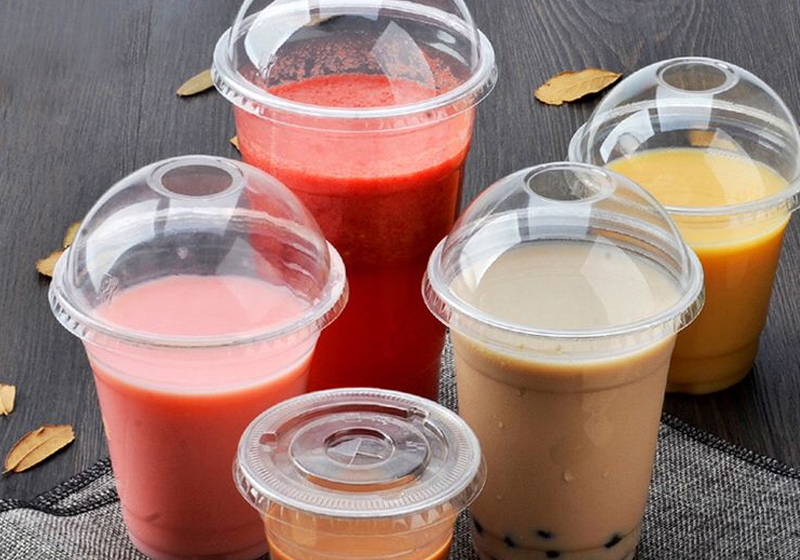
The flat or low-dome PP cup lid with a pre-punched or scored straw hole is the dominant format for cold beverages, bubble tea, iced coffee, smoothies, and fountain drinks. The straw hole is typically sized for standard 12mm or 8mm straws and may be formed as a clean punch-through opening, a cross-cut slit that the straw punctures on insertion, or a raised collar that grips the straw and reduces splash-back. Flat dome lids sit flush or with a minimal dome above the cup rim, which keeps the overall package height low for stackable storage and delivery bag placement. In bubble tea applications specifically, the straw hole is often sized at 12mm to accommodate wide-bore tapioca straw formats.
Sip-Through Lids for Hot Beverages
Hot coffee and tea lids feature a sip opening — either a pre-molded drinking spout, a fold-back tab, or a push-through perforated disc — that allows the consumer to drink directly from the lid without a straw. The sip opening geometry is carefully designed to control flow rate, prevent splashing, and allow steam venting to reduce internal pressure buildup during rapid temperature changes. PP's heat resistance makes it the appropriate base material for these lids, and the sip opening area is typically thickened or reinforced to maintain dimensional stability under contact with near-boiling liquid. Many hot cup lids also incorporate a recessed panel or raised feature on the top surface that indicates whether the lid has been opened, serving as a tamper-evidence function in takeaway service.
Dome Lids for Blended and Topped Drinks
High-dome polypropylene cup lids are designed for blended drinks, milkshakes, whipped cream-topped beverages, and parfaits where the topping extends above the cup rim and requires clearance space beneath the lid. The dome height varies by application — standard dome heights range from 25mm to 70mm above the cup rim — and the dome wall angle is engineered to prevent the topping from contacting and sticking to the underside of the lid during transport. High-dome lids may or may not include a straw hole, depending on whether the application involves strawed consumption or spoon-accessed products. The structural demands on a high-dome lid are greater than on a flat lid because the dome must support its own weight and resist deformation under stacking loads during storage and transport.
Peel-Off and Seal Lids
For delivery, retail, and tamper-evident applications, PP cup lids with a heat-seal flange or a peel-off film seal over the drinking opening provide additional security and leak resistance beyond what a standard snap-on lid can achieve. These formats are increasingly specified for third-party delivery platforms where the beverage may spend 20–40 minutes in transit and must arrive without spillage or evidence of tampering. The PP cup body and its flange geometry must be specifically designed to accept a heat-sealable film or a secondary snap-on retaining ring, and the compatibility between the lid and the cup needs to be validated as part of the packaging system specification rather than treated as interchangeable components.
PP Cup Lid Sizing: How Fitment Works and What to Measure
One of the most practically important and frequently misunderstood aspects of sourcing PP cup lids is the sizing system. A lid that fits incorrectly — too loose, too tight, or with the wrong engagement depth — will leak, pop off under light pressure, or require excessive force to apply, any of which creates operational problems in a busy foodservice environment.
PP cup lids are sized by their internal diameter at the point of engagement with the cup rim — the dimension that determines whether the lid snaps securely onto the cup. This is not the same as the outer diameter of the lid, which is always larger. The cup rim diameter and the lid engagement diameter must be matched within a tolerance of typically ±0.5mm for reliable fitment. Common lid sizes in the foodservice market are standardized around a set of rim diameters that correspond to cup volume ranges, but these standards are not universal across manufacturers — a 90mm lid from one supplier does not automatically fit all cups labeled as 90mm rim diameter from other suppliers.
| Common Rim Diameter | Typical Cup Volume Range | Typical Application |
| 70mm | 150ml – 250ml | Espresso, small hot drinks |
| 80mm | 250ml – 400ml | Regular coffee, medium cold drinks |
| 90mm | 400ml – 600ml | Large iced drinks, bubble tea |
| 95mm | 500ml – 700ml | Jumbo cold drinks, smoothies |
| 98mm | 600ml – 900ml | Extra-large format beverages |
When switching lid suppliers or sourcing lids separately from cups, always request physical samples and conduct a fitment test across the full range of cups the lid will be used with before placing a production order. Measure the cup rim outer diameter with a calibrated digital caliper and compare it against the lid's specified engagement diameter range provided by the manufacturer. Do not rely on descriptive sizing labels alone — "large" and "medium" designations vary between cup manufacturers and carry no standardized dimensional meaning.
Food Safety Standards and Compliance Requirements
Any PP cup lid used in commercial foodservice must comply with the food contact material regulations of the markets in which it will be used. Compliance is not optional and is not assumed simply because the material is labeled as polypropylene — it must be documented through test reports, migration testing, and material declarations that trace the resin and any additives used in the lid back to approved food contact substance lists.
Key Regulatory Frameworks by Market
- United States (FDA): PP cup lids must comply with 21 CFR 177.1520, which covers olefin polymers including polypropylene for food contact use. The regulation specifies permitted polymer types, additive restrictions, and the food types and temperature conditions under which the material may be used.
- European Union (EU Regulation 10/2011): This regulation covers plastic materials and articles intended to contact food, including PP cup lids. It defines an overall migration limit of 10 mg/dm² and specific migration limits for listed substances, and requires suppliers to provide a Declaration of Compliance supported by migration test data.
- China (GB Standards): PP food contact materials in China are regulated under GB 4806.7 (plastic materials and articles for food contact) and GB 9685 (standards for use of additives in food contact materials). Suppliers manufacturing PP cup lids for the Chinese market must demonstrate conformance with these standards through testing at accredited domestic laboratories.
- UK (post-Brexit): The UK has retained legislation substantially equivalent to EU Regulation 10/2011 through the Food Contact Materials Regulations 2010 and associated amendments. Declarations of Compliance referencing EU regulation are generally still accepted but should be reviewed against current UK-specific requirements for each supply chain.
What to Request from Your Supplier
- A Declaration of Compliance (DoC) specific to the lid SKU being purchased, referencing the applicable regulation and the food types and temperature conditions for which compliance has been established.
- Migration test reports from an accredited third-party laboratory covering overall migration and any specific migration limits relevant to the resin formulation used.
- Resin grade certification confirming that a food-grade polypropylene resin — not a general-purpose or recycled-content resin — was used in production of the lids.
- Confirmation that no recycled content is present in the food-contact layer if recycled PP was used in any part of the lid structure, as recycled content in food contact applications carries additional regulatory requirements in most markets.
Clarity, Color, and Visual Options for PP Lids
Polypropylene in its natural form is semi-translucent rather than optically clear — it transmits light but scatters it through the crystalline structure of the polymer, giving it a milky or frosted appearance when molded in standard thicknesses. This is an important distinction from PET, which is genuinely water-clear in its amorphous state and is the material of choice when maximum clarity is a primary packaging requirement. For cold drink applications where full product visibility through the lid is critical — bubble tea, layered drinks, fruit juice — manufacturers have two main options for achieving clarity in a PP cup lid.
The first approach is the use of clarified PP grades, which incorporate nucleating agents and clarifying additives that suppress crystallite formation during cooling, reducing light scattering and dramatically improving the clarity of the molded part. Clarified PP can achieve haze values below 10%, approaching the visual appearance of PET in many applications while retaining PP's superior heat resistance and chemical compatibility. The second approach is to use random copolymer PP (RACO-PP) rather than homopolymer PP, as the random comonomer distribution in copolymer grades inherently produces smaller crystallites and lower haze. Both approaches add cost relative to standard homopolymer PP but remain less expensive than PET while offering better hot-fill performance.
Color options for PP cup lids extend beyond natural and clear to include a full spectrum of custom colors achieved through masterbatch addition during the molding process. Black, white, branded colors, and seasonal promotional colors are all routinely produced, with the caveat that all colorant masterbatches used must themselves be food-contact compliant — a requirement that should be confirmed explicitly with the supplier rather than assumed. Printed decoration directly onto PP lids is less common than color molding but is available for high-volume custom orders, typically using pad printing or UV flexo processes on the lid top surface.
Customization Options: Branding, Embossing, and Private Label
For foodservice brands, chains, and retailers sourcing PP cup lids at scale, customization is a meaningful brand-building tool that transforms a functional component into a touchpoint that reinforces identity and differentiates the product on the counter and in delivery contexts. The main customization formats available on PP drink lids are as follows.
- Mold-embedded logo or text embossing: The most cost-effective and durable customization option. The brand name, logo, or design is engraved into the production mold and appears as a raised or recessed feature on every lid produced from that mold. There is no per-unit cost beyond the initial mold investment, which typically ranges from USD 3,000 to USD 15,000 depending on mold complexity and cavity count. Embossed features are permanent and cannot be changed without a new mold.
- Custom color molding: Specifying a proprietary brand color through a matched masterbatch formulation gives a distinctive visual identity without printing costs. The minimum order quantity for custom color PP cup lids is typically higher than for standard colors — commonly 50,000 to 200,000 units — to justify the color changeover and purge waste involved in dedicated color production runs.
- Pad printing or UV printing on lid surface: For multicolor logo applications or designs that include gradients and fine detail, pad printing or UV digital printing onto the molded lid surface is available from specialist converters. This adds per-unit cost and a secondary production step but allows full-color brand imagery without mold investment, making it more suitable for shorter runs or seasonal designs.
- Sticker or label application: The simplest and most flexible customization method — a pre-printed pressure-sensitive label applied to the top of the lid. This approach requires no mold changes and works with standard stock lids, making it accessible at very low minimum order quantities. The limitation is that labels can be removed, may lift at the edges in humid or condensation-prone environments, and do not have the premium appearance of molded or printed customization.
Sustainability Considerations for PP Cup Lids
Sustainability is an increasingly central consideration in foodservice packaging procurement, driven by consumer expectations, retailer commitments, and a growing body of single-use plastic legislation that specifically targets beverage lids as a high-volume waste stream. Understanding where PP cup lids stand on key sustainability dimensions helps buyers make informed sourcing decisions and prepare accurate communications for brand sustainability reporting.
Recyclability of PP Lids
Polypropylene (resin code 5) is technically recyclable and is accepted in kerbside collection programs in many countries, though collection and sorting infrastructure varies significantly between markets and even between municipalities within the same country. PP cup lids are small items that can pass through sorting equipment without being captured, which means that even in markets with strong PP recycling infrastructure, a significant fraction of lids end up in residual waste streams. Lidded cup systems where the lid remains attached to the cup through end-of-life — improving the likelihood that the lid is captured in the cup recycling stream — are being developed by several packaging system manufacturers as a practical response to this challenge.
Recycled Content and Bio-Based PP
Post-consumer recycled (PCR) PP is increasingly available for use in food contact applications, subject to specific regulatory approval processes that differ by market. In the EU, the use of recycled plastics in food contact materials requires authorization under EU Regulation 282/2008 or approval of the specific recycling process — not all recycled PP streams meet this requirement. Bio-based PP, produced from sugarcane-derived ethanol rather than fossil naphtha, is chemically identical to conventional PP and fully compatible with existing food contact approvals, offering a reduced carbon footprint without requiring changes to recyclability claims or processing equipment. Both recycled content and bio-based options carry a price premium relative to virgin fossil-based PP that should be factored into procurement cost modeling.
Single-Use Plastic Regulations Affecting Lid Design
The EU Single-Use Plastics Directive (SUPD) requires that cups for beverages and their lids and closures remain tethered — physically attached — to the cup during use, applying to products placed on the EU market from 2024 onwards. This regulation directly affects PP cup lid design for the European market, requiring either a tethered lid format integrated into the cup rim design or a separate tethering mechanism. Buyers sourcing PP plastic lids for EU distribution should confirm that their lid and cup system meets the tethering requirement applicable in their specific EU member state markets, as implementation timing and enforcement approach has varied somewhat between member states.
What to Check Before Placing a Bulk Order
Sourcing PP cup lids in volume — whether for a single outlet chain, a foodservice distributor, or a retail private label program — involves several verification steps that significantly reduce the risk of receiving product that does not perform as expected. The following checklist covers the most important pre-order checks based on common procurement failure points.
- Request physical samples before ordering. Test the lid fitment on your actual cup range, confirm the straw hole size matches your straw specification, evaluate the snap resistance (neither too tight nor too loose), and check clarity and color against your requirements under the lighting conditions of your service environment.
- Confirm food safety documentation is in order. Request the Declaration of Compliance and migration test reports as described in the compliance section above. Do not accept a verbal assurance of food safety compliance — the documentation must be in writing and traceable to the specific product being purchased.
- Verify the lid performs under your service temperature conditions. If you are using the lid for hot beverages, place a sample lid on a cup filled with liquid at your maximum service temperature and hold it for the duration a customer might carry the drink. Check for deformation, lid release, or any change in the fit of the sip opening.
- Check stacking efficiency and storage footprint. PP cup lids are supplied in stacked columns and must denest cleanly — separate from the stack one at a time — for both manual and automated lid dispensing. Test denesting by hand and, if you use an automatic lid dispenser, verify that the lid dimensions and rim geometry are compatible with your dispenser model before ordering.
- Clarify minimum order quantities and lead times. Stock PP cup lids in standard sizes and colors are typically available with short lead times and low MOQs from distributor stock. Custom colors, embossed logos, or non-standard dimensions require production runs with higher MOQs — commonly 50,000 units or more — and lead times of 4–8 weeks from artwork or mold approval. Align your ordering cycle and inventory planning to these timelines before committing to a custom lid program.
- Understand the packaging and shipment format. Lids are shipped in stacks, usually sleeved in polybags and packed into cartons. Confirm the number of lids per sleeve, sleeves per carton, and carton dimensions and weight to plan warehouse storage space and receiving logistics before the first delivery arrives.