


 English
 русский
 Español
 中文简体
中文简体Whether you're running a bustling food stall, catering a corporate lunch, or simply trying to minimize kitchen cleanup at home, paper soup bowls have become one of the most practical and versatile disposable foodservice solutions available today. These single-use containers have evolved well beyond the flimsy paper cups of the past — modern versions are engineered to handle hot broths, creamy chowders, hearty stews, and everything in between without leaking, collapsing, or losing their shape. In this guide, we'll walk through what makes a quality disposable soup bowl, which types suit different use cases, and how to make smart purchasing decisions.
Content
- 1 What Are Paper Soup Bowls and Why Do They Matter?
- 2 Types of Paper Soup Bowls: A Complete Overview
- 3 Key Features to Look for When Buying Paper Soup Bowls
- 4 Size Guide: Choosing the Right Capacity
- 5 Eco-Friendly and Sustainable Paper Soup Bowl Options
- 6 Best Practices for Using Paper Soup Bowls in Foodservice
- 7 Where to Buy Paper Soup Bowls: Retail vs. Wholesale
- 8 Cost Considerations and Budgeting for Paper Soup Bowls
- 9 Paper Soup Bowls for Home Use: Convenience Without Compromise
- 10 Frequently Asked Questions About Paper Soup Bowls
What Are Paper Soup Bowls and Why Do They Matter?
Disposable paper soup bowls are single-use containers manufactured from layers of paperboard — often coated with polyethylene (PE), polylactic acid (PLA), or aqueous coatings — to create a moisture-resistant barrier. Unlike standard paper plates, these bowls are specifically engineered to contain liquids for extended periods without soaking through. They come in a range of capacities, typically from 8 oz to 32 oz, and are used across restaurants, delis, food trucks, hospitals, schools, and households.
The importance of these containers has grown significantly with the rise of takeout culture and eco-conscious consumerism. Consumers increasingly demand packaging that is both functional and environmentally responsible, pushing manufacturers to innovate with compostable and recyclable materials. The result is a category of products that serves everyone from street food vendors needing portability to high-end soup restaurants seeking a branded, upscale presentation.
Types of Paper Soup Bowls: A Complete Overview
Not all paper soup containers are created equal. Understanding the different constructions helps you choose the right product for your specific application.
PE-Coated Paper Bowls
Polyethylene-coated bowls are the most common and affordable option. The thin PE lining on the interior prevents liquid absorption, making them suitable for hot and cold soups alike. They are widely available in bulk quantities and can handle temperatures up to around 200°F (93°C). However, PE-coated bowls are not compostable, and many recycling facilities cannot process them due to the plastic lining.
PLA-Coated Compostable Paper Bowls
Compostable soup bowls use a plant-based polylactic acid (PLA) lining derived from cornstarch or sugarcane. These break down in commercial composting facilities within 60–180 days. They perform comparably to PE-coated bowls for heat resistance and liquid containment but carry a slight premium in cost. For restaurants with sustainability commitments or those operating in cities with composting mandates, PLA-coated bowls are often the preferred choice.
Double-Wall Insulated Paper Bowls
Double-wall construction uses two layers of paperboard with an air gap between them to provide thermal insulation. This keeps soup hotter for longer while also making the outer surface comfortable to hold without burning your hands. These are especially popular for takeout and delivery orders where the bowl may sit for 15–30 minutes before being consumed. The added material makes them slightly more expensive, but the improved customer experience justifies the cost for many businesses.
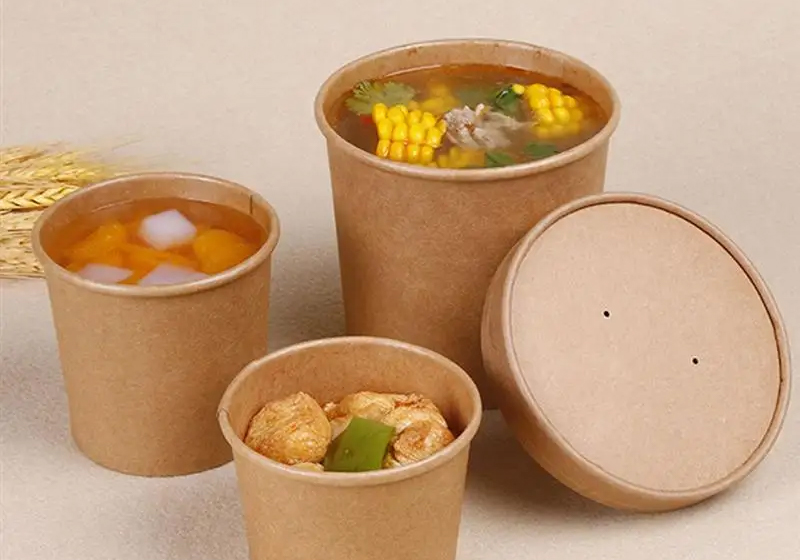
Kraft Paper Soup Bowls
Kraft paper bowls feature the characteristic brown, natural-fiber aesthetic that signals an eco-friendly or artisan brand identity. They are typically coated with PLA or aqueous barriers for liquid resistance. Kraft bowls are popular at farmer's markets, organic cafes, and any establishment that wants to visually reinforce its commitment to sustainability. The natural look also pairs well with minimal or eco-themed branding.
Printed and Custom-Branded Paper Bowls
Custom-printed paper bowls for soup allow restaurants and food brands to display logos, slogans, and artwork directly on the container. Minimum order quantities for custom printing are typically 5,000–50,000 units depending on the supplier. This option transforms disposable packaging into a marketing tool, reinforcing brand recognition every time a customer picks up their order.
Key Features to Look for When Buying Paper Soup Bowls
When evaluating disposable soup bowls for purchase, several technical and practical criteria should guide your decision:
- Leak resistance: A well-coated bowl should hold liquid without seeping for at least 30 minutes. Test samples before committing to bulk orders.
- Heat tolerance: Look for bowls rated for at least 185–200°F to safely contain fresh hot soup directly from the pot.
- Rim design: A rolled or reinforced rim provides structural rigidity and a better grip, especially important for larger 24 oz and 32 oz sizes.
- Lid compatibility: Confirm that the bowls are compatible with vented or flat paper lids to minimize spills during transport.
- Stack efficiency: Bowls that nest tightly without sticking together reduce storage space and speed up service during busy hours.
- Certifications: For compostable options, look for BPI (Biodegradable Products Institute) or TÜV certifications to ensure legitimate compostability claims.
Size Guide: Choosing the Right Capacity
Selecting the correct size for your intended use prevents both over-portioning and underfilling. Here's a practical breakdown of common capacities:
| Size | Best Use Case | Typical Setting |
| 8 oz | Appetizer or side soup, sampling | Buffets, tastings, kids' portions |
| 12 oz | Standard single-serve portion | Cafeterias, delis, quick-service restaurants |
| 16 oz | Hearty entrée-sized portion | Food trucks, takeout, hospital cafeterias |
| 24 oz | Large meal, stews, chili | Catering events, meal-prep delivery |
| 32 oz | Family portions, bulk take-home | Grocery deli counters, meal kit services |
Eco-Friendly and Sustainable Paper Soup Bowl Options
Sustainability has become a non-negotiable consideration for many foodservice buyers. The good news is that the market for eco-friendly disposable soup bowls has matured considerably, offering genuine alternatives to conventional plastic-lined products.
Compostable vs. Recyclable: Understanding the Difference
Compostable bowls break down into organic matter under specific conditions — typically in commercial composting facilities with controlled heat and moisture. Recyclable bowls, on the other hand, can re-enter the paper supply chain if they're accepted by local recycling programs. Aqueous-coated bowls (those coated with a water-based barrier instead of plastic) are more likely to be accepted by recycling facilities than PE-coated ones. Always check with your local waste management provider to confirm what's accepted in your area.
FSC-Certified Paperboard
The Forest Stewardship Council (FSC) certification ensures that the raw paperboard used in the bowl's construction comes from responsibly managed forests. Many leading suppliers now offer FSC-certified paper soup cups and bowls, which is a meaningful claim even for bowls that aren't fully compostable. Pairing FSC-certified paperboard with a PLA liner is currently considered the gold standard for sustainable soup bowl packaging.
Sugarcane (Bagasse) Paper Bowls
An emerging category, bagasse bowls are made from the fiber residue left over after sugarcane juice extraction. While technically more of a molded fiber product than a "paper" bowl, they occupy the same market niche and are fully compostable. They offer excellent heat resistance and a natural aesthetic. Their main limitation is a slightly higher price point and limited availability through mainstream distributors.
Best Practices for Using Paper Soup Bowls in Foodservice
Even the best hot soup paper bowls can fail if used improperly. Following these guidelines ensures the best performance and customer experience:
- Pre-heat the bowl: For very hot soups, briefly warming the bowl before filling it reduces thermal shock and can extend how long the soup stays hot.
- Do not microwave unless labeled safe: Standard PE-coated bowls are not microwave-safe. Look specifically for bowls labeled microwave-safe if reheating is part of your workflow.
- Match the lid properly: Using a mismatched lid creates gaps that allow spills. Purchase lids and bowls from the same product line or confirm compatibility before ordering in bulk.
- Avoid overfilling: Leave at least half an inch of headspace below the rim to prevent spills when lids are applied and the bowl is handled.
- Store away from moisture: Paperboard absorbs ambient humidity over time. Store bulk cases in a dry, climate-controlled area to preserve structural integrity.
- Use sleeves or carriers for delivery: For delivery orders, a cardboard sleeve or bowl carrier helps prevent tipping and provides extra insulation.
Where to Buy Paper Soup Bowls: Retail vs. Wholesale
Your purchasing channel should align with your volume needs and budget. Here's a comparison of the main options for sourcing bulk paper soup bowls:
| Channel | Pros | Cons |
| Restaurant Supply Stores (e.g., WebstaurantStore, Restaurant Depot) | Competitive bulk pricing, wide selection | Membership may be required; shipping costs on heavy items |
| Online Wholesale (Amazon Business, Alibaba) | Convenient, easy price comparison | Quality can vary; shipping times for large orders |
| Specialty Eco Suppliers (e.g., EcoProducts, Vegware) | Certified sustainable options, transparent sourcing | Higher per-unit cost, may have MOQ requirements |
| Big-Box Retail (Costco, Sam's Club) | Accessible for small operators, no account needed | Limited variety, less customization |
| Direct from Manufacturer | Best pricing at high volume, custom print options | High MOQs, longer lead times |
Cost Considerations and Budgeting for Paper Soup Bowls
Pricing for paper soup bowls wholesale varies significantly based on material, construction, size, and order volume. As a general benchmark, standard PE-coated 12 oz bowls run approximately $0.05–$0.12 per unit in case quantities of 500–1,000. Compostable PLA-coated equivalents typically cost $0.10–$0.20 per unit. Double-wall insulated bowls may reach $0.25–$0.40 per unit at similar volumes.
When calculating your total cost, don't forget to factor in compatible lids, which are usually priced separately and add $0.03–$0.10 per unit. For businesses going through 200–500 bowls per day, even a $0.03 per-unit difference between suppliers amounts to $6–$15 daily, or $2,000–$5,000 annually — a meaningful number worth optimizing. Request samples from at least two suppliers and conduct side-by-side comparisons before locking in a vendor relationship.
Paper Soup Bowls for Home Use: Convenience Without Compromise
While much of the discussion around disposable soup bowls centers on commercial foodservice, there's a substantial and growing market for home use. Consumers purchase these bowls for parties, camping, emergency preparedness, and everyday convenience when they want to minimize dishwashing. For home users, 25-count or 50-count retail packs are the practical entry point, and the emphasis shifts toward comfort features like double-wall construction and wide, stable bases.
For those hosting large gatherings, a case of 500 bowls purchased through a wholesale channel is more economical and eliminates the mid-party scramble when supplies run low. Home cooks who meal-prep soups and stews in advance also find that having stackable, lidded paper bowls on hand makes portion-controlled grab-and-go lunches far more practical than transferring soup into reusable containers each morning.
Frequently Asked Questions About Paper Soup Bowls
Are paper soup bowls leak-proof?
High-quality coated paper soup bowls are highly resistant to leaking under normal conditions — they can typically hold liquid for 30 minutes to several hours depending on the coating and construction. They are not fully waterproof indefinitely; prolonged soaking (beyond 2–3 hours) may eventually cause softening of the paperboard. For extended holding periods, double-wall or heavier-gauge bowls perform best.
Can you put paper soup bowls in the microwave?
Standard PE-coated paper bowls are generally not recommended for microwave use, as the coating can deteriorate and potentially leach into food at high temperatures. Some manufacturers produce specifically microwave-safe versions, which will be clearly labeled. Always check the product packaging before microwaving.
How do paper soup bowls compare to foam (Styrofoam) bowls?
Paper bowls are generally considered the more environmentally responsible choice, as foam is not recyclable in most municipalities and does not biodegrade. In terms of insulation, double-wall paper bowls approach the performance of foam bowls. Paper bowls also allow for higher-quality printing and branding. The main remaining advantage of foam is its extremely low cost per unit in very high volumes.
What soups work best in paper bowls?
All liquid-based soups — from thin broths and miso to thick chowders and chili — work well in coated paper bowls. Very acidic soups (like tomato bisque) may slightly accelerate coating degradation over extended holding periods, but for typical service windows of under two hours, performance remains excellent. Oil-heavy soups are also well-contained, as most interior coatings are both water- and oil-resistant.